The story of bead crochet snakes is a rich one that involves the geographical area
formerly referred to as the Balkans and known today as Southestern Europe. Crochet, with or without beads, was well
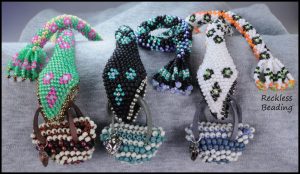
established in the Ottoman Empire by the 1870s. Like the belts shown above, most bead crochet items
made before World War I were done by women for their own use.
There are few examples of beadwork souvenirs made by
nineteenth- and early twentieth-century civilians incarcerated in Ottoman prisons, but the bead crochet snakes that intrigue
people today were made after 1915.
The majority of beadwork reptiles made in the Balkans can
be divided into three types: snakes and lizards made by Turkish soldiers imprisoned in British military and civilian internment
camps during World War I, snakes made by villagers in parts of Southeastern Europe for their own use, and less elaborate snakes
made to be sold at markets as souvenirs or made specifically as jewelry.
WORLD WAR I:
Some of the 150,000-250,000 Turkish soldiers captured by the
British, Australian, Russian, and French armies were housed in camps located in Egypt, on the island of Cyprus,
and at Salonika.
To combat the boredom of imprisonment, prisoners of war were
allowed to craft souvenirs that could be given as gifts, bartered for amenities such as extra food, or sold in
local shops and by street vendors. Many Turkish soldiers used beads to make handbags, purses, necklaces, bracelets,
bookmarks, belts, covered bottles, snakes, and lizards.
While most of the beadwork snakes and lizards were undoubtedly
made in Middle-Eastern camps, some of them were made by the one hundred Turkish men
interned at Knockaloe Camp on the Isle of Man. Family legends tell of Turkish prisoners trading beadwork
snakes to locals for food.
Whether made in Egypt or England, the snakes share similar design
characteristics. Snakes might seem like a strange choice today but they were actually regarded as good luck symbols
in parts of the Ottoman Empire. The beadwork versions range in length from 13 inches (33 cm) to 18 feet (5.5 m) with
a common size being around 60 inches (152 cm)long and 2-3 inches (5-7.5 cm) around.
The snakes were done with bead crochet: beads were strung in
a pattern and the snake was crocheted around in a tube from tail to mouth. The common patterns for the top decoration
were a zig-zag or diamond shape. The mouth was a two-part constuction, sometimes holding a beadwork tongue that is sewn
in afterwards.
Large snakes were stuffed with fabric strips, used yarn, horsehair,
and string to prevent them from collapsing. The large snakes usually have some kind of writing on the belly: a date
or phrase such as TURKISH PRISONER or TURKISH POW. The jaws of the snakes were usually decorated with a triangle, diamond,
or what looks like a capital A.
Turkish POWs also made bead crochet lizards or salamanders
but in fewer numbers than the snakes. These range in size from 3.5 inches (9 cm) to 9 inches (23 cm) with a common size
being a little over 7 inches (18cm). Some of the lizards are caught in the mouths of snakes but many stand on their
own little legs.
Common decorations are stripes, zig-zags, diamonds in various
forms, and an all-over dotted pattern. Like the snakes, the lizards have a two-part mouth that sometimes contains a
beadwork tongue. The lizards may have a phrase or date worked in beads on the belly.